Eggs From Cottonwood Creek Farm

Pasture raised eggs are an add-on option this year for the CSA. We are super excited, and feel so lucky to be getting the eggs from Cottonwood Creek Farms.

Eggs

I have spent a couple days at Cottonwood Creek Farms gathering eggs, and doing other chicken things. I can personally tell you this is a great farm run by Matt Kautz and his family. They have another little boy now.

Cottonwood Farmers
If I were a chicken I would be so happy living there. The chickens have pastures, barns, a creek, and they are free roam where ever they like on the farm. I gathered eggs one day with Matt’s mom and we wandered around the farm with buckets to gather the eggs. We walked several acres and gathered eggs from nest boxes, under a tractor, we found eggs in some storage barns and out buildings. It was like an Easter egg hunt. The hens can go where they like.

Chicken paradise.

Chicken

The eggs from Matt’s hens are big and brown and just beautiful. If you haven’t had ‘real’ pasture raised eggs I hope you consider this add-on option this year. Amy is bringing some eggs to the pick-up this week. Pick one up. You will feel a difference in a pasture raised egg. The shell texture is very different than a store bought egg, and the weight is different too. I describe it as having a ‘heft’ that store bought eggs don’t have.

They of course taste great. They are really rich tasting compared to store bought eggs.

There are several studies showing that eggs from hens raised on pasture are much better for you than store bought. Pastured eggs have:

  • 4 to 6 times as much vitamin D as supermarket eggs
  • 1⁄3 less cholesterol
  • 1⁄4 less saturated fat
  • 2⁄3 more vitamin A
  • 2 times more omega-3 fatty acids
  • 3 times more vitamin E
  • 7 times more beta carotene

Read more

I hope you consider this add-on option. The first time you crack one open you will be hooked, you just know that came from a really happy hen.

I’ll be including eggs in my blog recipes this year! Egg-citing huh?

Posted in 2013, Newsletter | Comments Off on Eggs From Cottonwood Creek Farm

Please CHANGE SUBSCRIPTION to Red Wagon Organic Farm blog

You may wish to change your subscription to our blog. We are posting things a little different this year and being subscribed will cause you to get numerous emails from us.

To change your subscription:

  • Open the email message that notified you of this blog post.
  • Go to the bottom of the email message and click Manage Subscriptions.
  • This will open the WordPress web site and you will see your Delivery frequency.
  • We recommend that you change your subscription to Daily or Weekly instead of Immediate. This will help so you don’t get 5 or more notification emails in one day from our blog.

You can also choose to unfollow our blog if you’d rather just check the blog on our web page instead.

  • From the WordPress web site place your cursor over Red Wagon Organic Farm CSA and the word Unfollow will appear. Click Unfollow and you will no longer receive notification emails.
Posted in 2013, Newsletter | 1 Comment

2013 CSA What’s New?

Welcome and welcome back new and returning CSA members. What a ride this winter has been. Cold, dry, then snow, snow, cold again, glorious spring and more snow! Yeah moisture! But, boy-o-boy, let’s warm up a little to get growing already! Spring crops are in the ground waiting for warm days.

We are excited for the 2013 season and hope you are, too. We have a few new changes in the CSA. We are partnering with a few other farms and ranchers. There are some people and products we love and we want to provide you the option of buying ethically grown or raised products you might not otherwise be able to obtain.
One of the products we want to offer you is Natural Homestead Beef raised by Frank Silva.

Frank Silva

Frank sells his beef at the Boulder and Longmont Farmers’ Markets. He also sells to some local restaurants. Frank’s booth has been next to ours at the Boulder Farmers’ Market for years and because of this we have long talks with Frank, between helping customers. We hear him speak passionately about his animals’ welfare. We hear and share his worry about water and drought conditions.

I can speak from happy personal experience to the fantastic flavor, and quality of Frank’s beef. It sounds cliché to say that I can taste the care Frank puts into his product. But, I can. The same way I think our vegetables from Red Wagon taste better than vegetables from other farms, because of the time and care we put into our crops.
Frank raises Highland cattle that are descended from a tradition Scottish breed. They are slow to mature, and because of the slow maturity rate, the flavor of the beef is more developed than faster maturing breeds.

Frank’s cattle are of course ethically pasture raised and traditionally finished. I prefer traditionally finished beef to grass finished. I find traditionally finished beef to have superior beef flavor to harsher grass finished flavor. Also, I find the meat texture is more pleasant and tender than grass finish, which I find often unpleasantly firm.

So what is ‘traditionally finished’? To Frank it means the cattle have free access to alfalfa, grass hay, brewer’s mash (Frank has a contract with Coors to use their brewer’s mash) and sunflower seeds. Yum that, I want that for breakfast….and one of Frank’s burgers for dinner!

Here is Frank’s website. Check it out. There is lots of info there, email him or me if you have any questions.
When you sign up for our CSA there is an ‘options’ page. You will see the beef packages what Frank is offering on that page. Since this is our first year offering ‘add-ons’ other than fruit, we are asking for feedback and suggestions, now or anytime, if there is something you would rather see offered. Different sizes? Different cuts? Please let us know.

In the next couple weeks I’ll do a few more blogs telling you a little more about some of the other products we are offering. If you have questions in the meantime, please post them in the comment section here. If you have a question, maybe someone else does too, so please share them.

See you at your CSA pickup soon!

Posted in 2013, Newsletter | Tagged | Comments Off on 2013 CSA What’s New?

What does all the April snow mean for our farm?

2012 was very dry in Colorado and we used up a lot of the water that was stored in the state’s reservoirs. The 2013 farm season started out looking pretty dire in March. We hadn’t gotten much snow to replenish our water supply. At the end of March the South Platte snowpack (where we get some of our irrigation water) was at 71% of normal. But then we had record-setting snow in April. By the end of April the snowpack had increased to 94% of normal. The snowpack is even higher with the May 1 snowstorm.

Rhubarb plants peaking though the snow.

Rhubarb plants peaking though the snow.

What does all this snow and cold weather mean for our farm? There are some good things, some bad things, and some uncertainties.

The April snow has been a huge boost to our snowpack. Things look very good in terms of irrigation water availability for the summer. It is hard to express what a big deal this is for farms all over Boulder County and beyond.

It got down to 9°F in mid-April. This is the coldest it has been during April in the 10 years that we have been farming. The leaves of our garlic got singed by the cold. Garlic is very hardy and we’ve never seen this before. Our rhubarb also got killed back in April. The leaves have started to grow again, but the rhubarb will be a little behind.

Our garlic is recovering from cold April temps.

Our garlic is recovering from cold April temps.

The snow also helped to protect some of our crops. We had a lot of things like spinach, lettuce, peas, and fava beans that we planted in March. The snow made a nice blanket to protect these crops from that 9° night in April. The plants probably would have suffered significant damage without the snow blanket to protect them.
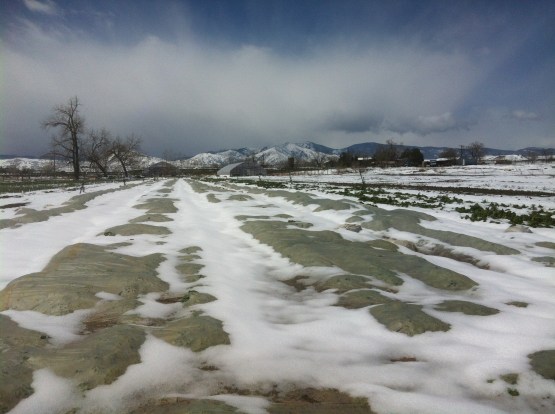
The snow (along with row cover) provides a nice blanket for spinach.

The snow (along with row cover) provides a nice blanket for spinach.

The downside is that the snow, cold weather, and moisture have delayed our growing season substantially. We have some crops planted, but they haven’t really been growing while buried under snow or sitting at temperatures in the 30s. On wet days we can’t do any work in our fields. Our plowing and planting have been delayed by weeks. We just can’t plant into snow or mud. We would normally have 4 successions of spring crops planted by this time of year. These are crops like lettuce, arugula, spinach, radishes, turnips, etc. This year we only have 2 successions planted as of the beginning of May. We had 10 acres planted by this time last year, but now we only have 3 acres planted.
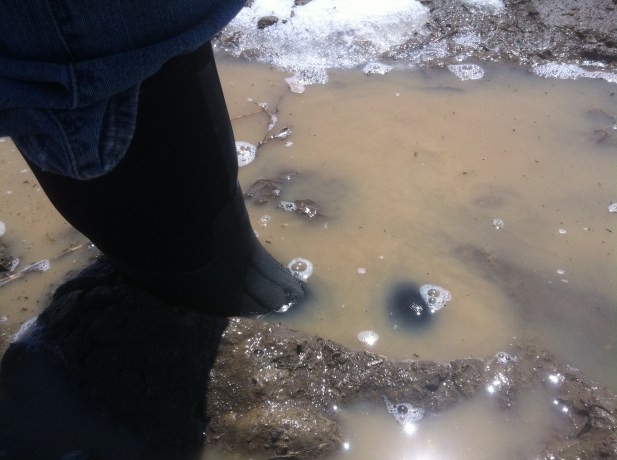
You just can't plant seeds into ankle-deep mud.

This is my boot getting sucked into the mud in one of our fields. You just can’t plant seeds into ankle-deep mud.

This spinach planted on March 15 is just putting out its first true leaves. We would normally harvest this May 1.

This spinach planted on March 15 is just putting out its first true leaves. We would normally harvest this May 1, but it will be ready closer to the end of May this year.

Our farm workers have had a lot of snow days and missed working for most of April. It’s nice to have a snow day here and there, but these people are counting on their paychecks and I know it has been difficult financially. And the days the did get to work in April weren’t fun. The back-to-back snow storms made working conditions cold, wet, and muddy.
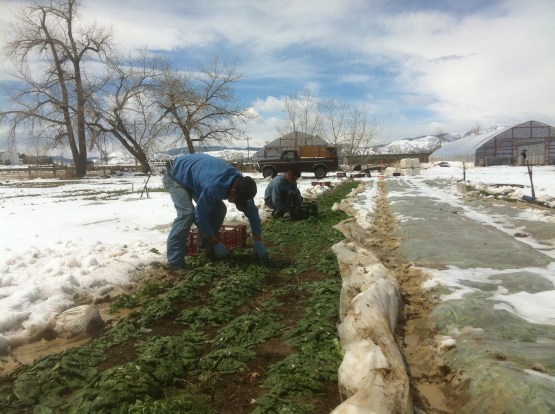
Harvesting spinach through snow is a cold, wet, messy job.

Harvesting spinach through snow is a cold, wet, messy job.

All that work we didn’t get to do in April didn’t just go away. It still needs to happen, so now we have 2 months’ worth of work to do in May. I keep telling our crew that they are in for a crazy few weeks!

Our sales at the farmers’ market are down by about 30% so far this season because we don’t have much to sell. We would usually have all kinds of crops by the beginning of May: spinach, lettuce, arugula, kale, mustard greens, green garlic, walking onions, radishes, turnips, and lots more. But so far this year we’ve pretty much just had over-wintered spinach.

By the last full week in April we thought we were in the clear. But then we got almost a foot of snow on May 1! We were a bit worried about some of the more tender crops that we had already planted. I was very happy on May 2 when I went out to our hoop house and saw that the tomato plants in there survived.

We were lucky that our tomato plants in the hoop house didn't freeze.

We were lucky that our tomato plants in the hoop house didn’t freeze.

And I almost couldn’t believe it when I checked our walls o’ water on May 2. We put out several hundred tomato plants on April 26. I thought for sure that they would have frozen in the May 1 storm. But they were toasty and happy when I peeked inside!
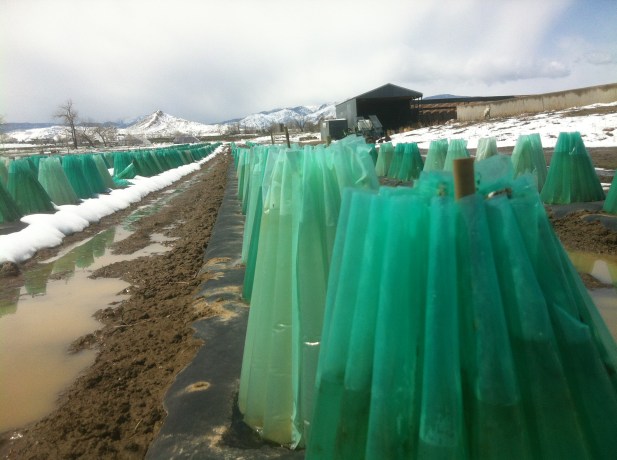
We plant tomatoes in several hundred walls o' water in April.

We plant tomatoes in several hundred walls o’ water in April.

I thought for sure our tomato plants would freeze in our walls o' water!

I thought for sure our tomato plants would freeze during the May 1 storm in our walls o’ water!

We would normally have things like our kale and chard transplants in the ground. And they would be almost ready to harvest. But we are just finally getting them planted this week. We planted things like fava beans, peas, and beets a few months ago. Fortunately they germinated and started growing, but then they sort of went into hibernation in April and just sat there. They are growing again, but they are now about a month behind.

We are worried about having killing frosts later than usual. The average date of the last frost in Boulder is May 15. But, we have been setting record lows and we are worried this trend might continue. I don’t know if this fear is rational or not. But the cold weather in April has us worried about cold weather in May.

So far this week is off to a good start. We have several thousand transplants to get in the ground. Cool, cloudy weather is perfect for transplanting as it reduces transplant shock. If the weather cooperates and we can get back on schedule in May, we should catch up to a normal growing season in June. Keep your fingers crossed!

Posted in 2013, Farm | Comments Off on What does all the April snow mean for our farm?

Chard Stem Gratin

Submitted by Marilyn

  • leftover chard stems (broccoli or cauliflower would be good this way too)
  • bits of fried bacon or pancetta, optional
  • chopped/sliced garlic
  • chopped parsley
  • seeded, coarsely chopped tomato or roasted pepper
  • optional cream
  • grated cheese, optional

Bring a pot of salted water to a boil. Remove strings from the chard stems if necessary (like you would celery) and cut into bite-sized pieces. Drop into the water and cook until tender, just a few to several minutes, depending on their toughness. Drain and place into a buttered baking dish sprinkled with with the bacon/pancetta, garlic, parsley, tomato/pepper or any other savory/salty ingredients you desire. Cover with a little cream and cheese if desired, and bake in a very hot 450°F oven or broil until golden on top.

Posted in 2012 | Comments Off on Chard Stem Gratin

Sauteed Greens

Submitted by Marilyn

Serves 4

  • 1 lb. mixed greens, with tender stems
  • 1-2 Tbsp. extra virgin olive oil
  • 1-2 Tbsp. minced garlic
  • Salt and freshly ground black pepper
  • Vinegar or lemon juice, optional for seasoning, see Note

Shake the rinsed greens in a colander to remove the excess liquid, but the leaves don’t have to be completely dry. Heat a large pot over high or medium high heat until hot.

Add the olive oil followed by the garlic and cook for a few seconds until it is light brown. Be careful not to let your oil smoke or burn the garlic. Add a couple of handfuls of greens and toss with tongs, incorporating the garlic so it doesn’t burn on the bottom of the pan. Add the remaining greens all at once, or in batches if your pot isn’t large enough to hold it all at once. Toss constantly so the greens wilt evenly.

When wilted, taste first, then season with salt and pepper. Sometimes greens have a natural saltiness so you don’t want to over salt. Continue cooking over high heat, tossing often, until the excess liquid evaporates.

Turn greens out into a bowl and season with vinegar or lemon juice. Can be served hot, at room temperature, or refrigerated for up to 2 days and eaten as a cold “salad”.

Note: The acidity of the vinegar or lemon juice will cause the greens to lose their beautiful green color, so you can omit it if you prefer.

Posted in Recipes | Comments Off on Sauteed Greens

Summer Vegetable Caponata

Submitted by Jessica Hersh

  • 1/2 cup extra virgin olive oil
  • 1 Tbs brown sugar
  • 1/2 cup balsamic vinegar
  • 3 lbs summer vegetables (eggplant, zucchini, peppers, yellow squash, green beans)
  • 1 medium or 2 small onions
  • 3-5 cloves of garlic
  • 1 large can small diced tomatoes in juice or 2 lbs fresh tomatoes, peeled and diced
  • 2-3 Tbs capers
  • black pepper
  • salt

Prepare the eggplant, zucchini, and yellow squash as follows: wash, trim, and cut into small bite-sized pieces. Peel the onion and dice it. Peel the garlic and cut into thin slices. Put the oil, sugar, and balsamic vinegar into a heavy-bottomed pot and heat over medium high until bubbly. Add the eggplant and onion and cook for a few minutes, stirring occasionally to prevent sticking and burning. Add the rest of the vegetables (including tomatoes and garlic.) Add capers. Stir well, turn heat down to low and cover the pot.

If the mix seems very dry add half a cup of water – you want to allow this dish to stew for hours without drying out. Cook over low heat for at least 2 hours, checking water content and stirring every 10 minutes or so. When the dish is fully cooked, all the vegetables should be very soft and falling apart and it should be thick, not soupy. At this point, remove it from the heat. Add salt and pepper to taste. Serve hot or allow to cool and serve cold. You can eat this as a salad, a side dish, an omelet filling, tossed with pasta, topping a frittata, as a dip for chips or bread, as a crostini topping, a sandwich filling, or just a dip-the-spoon in snack.
Enjoy!

Posted in 2012 | Comments Off on Summer Vegetable Caponata

Dilly Beans

Dilly Bean Jars

Here is the recipe I used, which is adapted from Sandor Katz’ book Wild Fermentation: The Flavor, Nutrition, and Craft of Live-Culture Foods.

You will need:

  • Sealable canning jars (I used pint jars)
  • A pot big enough to cover your jars with water
  • String beans
  • Garlic
  • Salt (I used coarse Kosher salt)
  • Whole dried chili peppers
  • Celery seed
  • Fresh dill (flowering tops if available)
  • White distilled vinegar
  • Water

Start by boiling your jars and lids for 5 minutes or so to sterilize them. While your jars are boiling, prep your green beans by chopping off just the very tips. Peel as many cloves of garlic as the number of jars you’re making.

For each jar, combine 1 cup of vinegar and 1 cup of water in a saucepan and bring to a boil. While your vinegar and water mixture is heating up, place the following in the bottom of each jar: 1 garlic glove, 1 teaspoon of salt, one whole dried chili pepper, 1/4 teaspoon celery seed, and one flowering dill top (or a small bunch of dill leaves). Pack your jars full with green beans. (Note: I made one jar with the chili pepper and one without. Since I’ve never made these before I wanted to test the spice level this time.)

When your vinegar/water mixture has boiled, fill each jar, leaving 1/2 inch of space at the top. Seal up your jars and process them in a boiling water bath for 10-15 minutes. When they are done, your jars could take anywhere from 1 second to 30 minutes to seal. (You’ll know they are sealed when you press down on the middle and it doesn’t spring back at all.)

Give these about 6 weeks before opening for the flavors to meld…if you can stand to wait that long.

Posted in 2012, Beans, Recipes | Comments Off on Dilly Beans

Tomato Soup

Submitted by Kate Martin

  • 1 large onion, chopped
  • 2 cloves garlic, chopped
  • 1 1/2 Tbs butter
  • 1 Tbs olive oil
  • 2 tsp. each dried thyme and dried basil
  • 3 Tbs tomato paste
  • 3 lbs. fresh ripe tomatoes, peeled, seeded and chopped
  • salt and pepper to taste
  • 4 cups chicken broth

Saute onion and garlic in butter and olive oil. Add spices, tomato paste, salt, pepper and tomatoes. Cook for 10 minutes. Add broth. Cover slightly and simmer 30 minutes more. Puree in a blender, food processor, or using an immersion blender. This recipe freezes great and is a perfect dish to pull out on a cool fall evening.

Posted in 2012, Recipes, Soups, Tomatoes-Tomatillos | Comments Off on Tomato Soup

Roasted Tomato Sauce

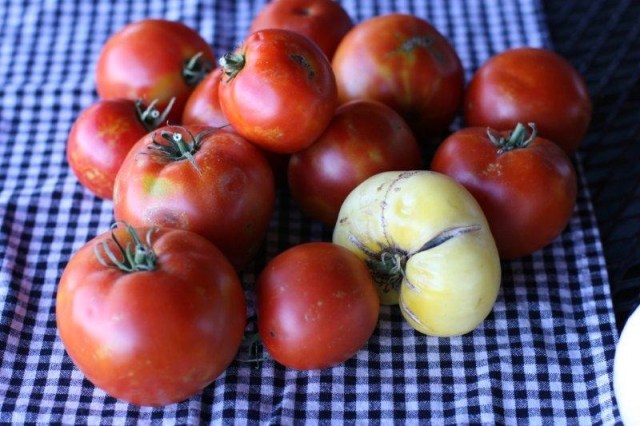
Here are 5 pounds of tomato seconds.
Tomato Seconds

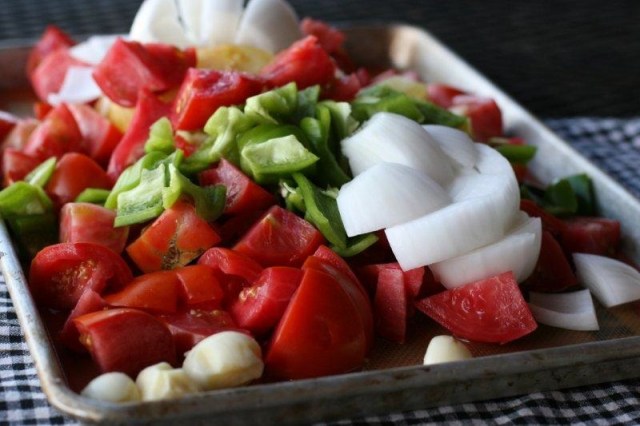
I think I’ll use the garlic and pepper from this week’s share in my sauce. You can do that too or just use tomatoes. I added an onion from last week’s share in my sauce too.

Core and roughly cut everything up and put it on a baking sheet that will hold it all. You might use 2 9X13 baking pans.
Sliced Ingredients

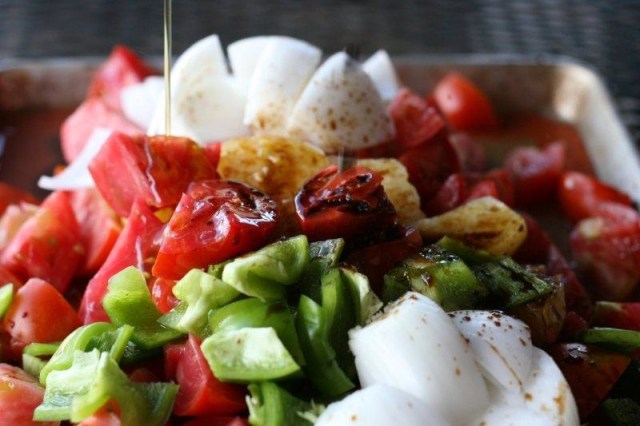
Now pour olive oil and balsamic vinegar over the whole thing.
Topped with Balsamic

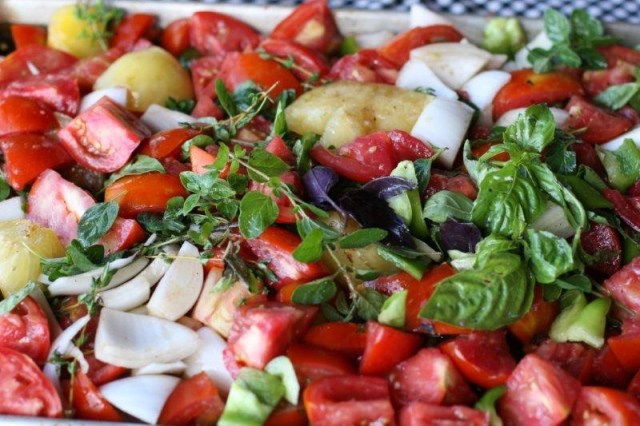
And mix it all up with salt and pepper and any herbs you have in your garden and put that in a preheated 450°F oven to roast for at least 45 minutes and up to an hour.

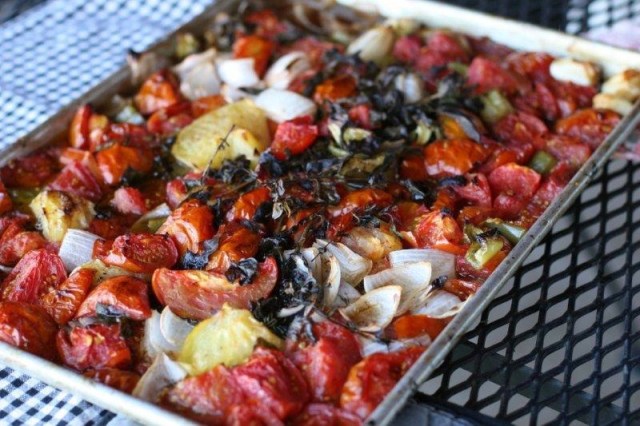
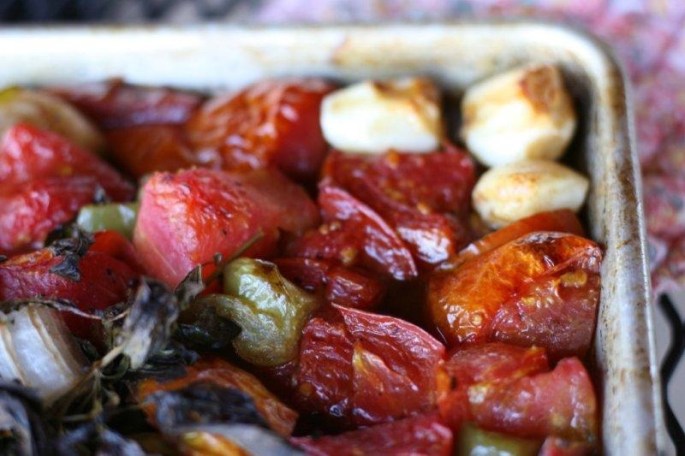
It should look something like this when it is done roasting. There is a lot of liquid so be careful removing it from you oven.
Roasted Tomato Sauce

Roasting caramelizes sugars and condenses flavors, you can almost see that here.
Roasted Tomato Sauce

I dump everything into a bowl and fish out the woody and too charred herbs and throw them away. Then I hit the roasted tomato mixture with an immersion blender.
Roasted Tomato Sauce Blended

I got just over two quarts of sauce out of my 5 pounds of ‘seconds’ tomatoes.
Roasted Tomato Sauce
When life gives you seconds, make something second to none.

Posted in 2012, Recipes, Tomatoes-Tomatillos | Comments Off on Roasted Tomato Sauce