Become a Working CSA Member!  See details →

Category: 2014

  • Watermelon Bandits

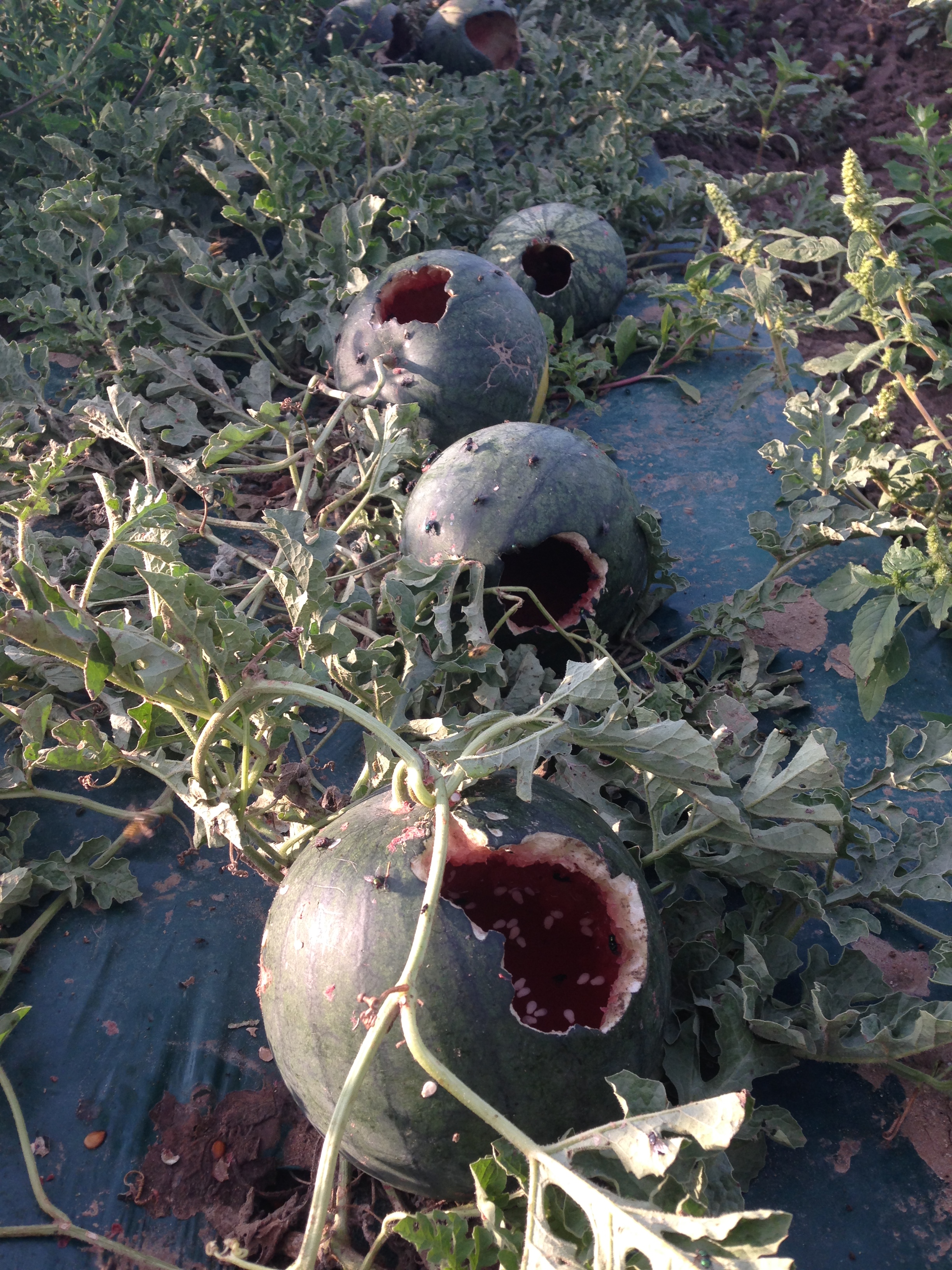
    Sigh…Every year we have crop failures. Blame the raccoons for the watermelons. We have a gorgeous field of watermelons that are just about ripe. But the raccoons know this, too. I think every raccoon in Boulder County must be visiting our farm at night. We have a field full of hundreds of watermelons. About 70% of them have been eaten by the raccoons. I can just imagine the tubby little raccoons sticking their sharp claws through the watermelon rind, then using their paws to scoop out all the delicious, sweet flesh of the watermelon. Then they waddle away with their full bellies after a night of gorging in our field.

    Watermelons eaten by racoons
    Watermelons eaten by racoons

    A few years ago the coyotes found the watermelon field. They would pull the melons off the plant and roll them away. Then they would open them up and eat every last bit up to the green skin, so that skin would collapse on itself.

    The watermelons are at our farm on Valmont Road. Wyatt says that next year we will try putting the watermelons at the farm where we live, on 63rd Street. The soil at 63rd Street isn’t as good for melons–it has too much clay. But we have 2 big dogs who woof all night and keep the coyotes and raccoons away. Maybe then you will all get to enjoy some watermelon on a hot August day.

  • My Favorite Tool

    scuffle hoeOne of the many important jobs on the farm is weed mitigation.  From the chill of early season to the heat of the summer, the battle between our crops and weeds is full on. Weeds like Mallow, Vine Weed, Thistle, and Dock Root sprout up everywhere. There are some weeds that are edible like Purslane and Wild Amaranth and then some alien-looking ones, like Dodder, that is a parasitic weed that looks like strange yellow spaghetti. Edible or not, they are weeds and enemy to any farmer. If the they win out, our crops struggle to compete.

    Weeding takes many forms on the farm. Much of the work is done by hand. This is slow, but effective if executed properly. Early in the season, full days are devoted to pulling out these pesky weeds. Knee pads and thin gloves ease the pain of being crouched over all day. When I am weeding, I find I have three positions I alternate through to help the repetitive stress. Bending at the waste, kneeling, and crouched on one knee.

    Then, there are some tools that aid the weeding- bludgeon hoes, long skinny shovels, pitch forks. Of all these, my favorite is something we call a scuffle hoe. Like any other tool, it has a long wooden handle, but on the end, instead of the normal spade-type blade, it has a thin looping blade 1 1/2 inches wide. Instead of hacking away at the weeds with a large swooping motion from the shoulder, with the scuffle hoe, you place the blade on the ground and push it under the surface of the soil and pull back and forth. This cuts the roots and is quick and effective on young tender weeds.

    With this tool, I get into a rhythm that comes with muscle memory. Push and pull, watch for the garlic or pumpkin plant, get as close as possible. Take a step forward and repeat. My mind can wonder, but, because of my competitive streak, I always keep one eye on those working beside me, being sure not to fall behind or even better just ahead of them.

    The fields are looking clean this year, no small task with a small work crew. We are winning out, it seems.

  • Celery Storage and Ideas

    Either you love it or you hate it. Honestly, I don’t get what isn’t to like. I understand why someone might not like arugula. I sort of get why raw kale salad might take some getting used to. But when I hear “I hate celery’. I don’t get it.
    Celery adds a delicious crunch and mildly mineral, grassy, bitter taste and water content to salads and stir fries. It is a great vehicle for dips and for stuffing with things like cheese and peanut butter.
    It balances flavors in soups and stew when you use it with carrots and onions.
    It’s great for juicing.
    It’s texture and flavor are unique and unexpected in so many dishes.

    This is the first year Wyatt has grown celery and he did a great job. Look at how beautiful it is.

    Celery

    The leaves were so big I couldn’t get the whole bunch in the picture. You won’t ever see that many leaves on a bunch of celery in the grocery store. You won’t ever see celery this fresh in a store.

    Celery will keep in your produce drawer for a long, long time if you store it correctly.
    First cut off most of the leaves, use those in a salad or to make a vegetable stock.
    You want to keep the root of the plant moist for best keeping. I like to wrap the root of the plant in a moist paper towel and then put the whole thing in a plastic bag. Don’t seal the bag, let some air flow.

    Trimmed bottom

    Pop this into a plastic bag, then into the produce drawer. When I use some of the celery, if the paper towel has dried out I just re-wet it. This will keep for at least a couple weeks.

    Wrapped in Towel

    Some people like to cut off the root and put the stalks of the celery in a glass of water, like you would a bouquet of flowers and then put that in the refrigerator. I find that when I have tried that my celery didn’t last as long as the paper towel in the plastic bag method. Plus, who has room for a vase of celery in their refrigerator?

    Make sure you tell Wyatt how much you like celery, or he might not grow it again next year!!
    Have a great week.

  • CSA week 12

    Week 12!  This week we hope to bring you:
    Regular Share
    -Carrots
    -Beets
    -Leeks
    -Green Beans
    -Choice: Zucchini OR Cucumber
    -Choice: Basil OR Parsley
    -Choice: Kohlrabi OR Celery OR Onions

    Large Additions
    -EXTRA Zucchini OR Cucumber
    -EXTRA Choice: Kohlrabi OR Celery OR Onions
    -Potatoes

    Beet Wall

  • Garlic as a Vegetable

    garlicThere is quite a bit of folklore surrounding garlic, touting it’s health benefits and even it’s ability to ward off vampires. Regardless of whatever magical powers it may possess- real or imagined, let’s talk about garlic it is most simple quotidian form- As a vegetable.

    On the farm, our garlic crop is one of the most anticipated and revered. It takes up a lengthy stay in the field, going into the ground in the late fall and stays in there until mid-summer. In early spring the pointy green garlic plants send up their spirally scapes that offer a succulent taste of what’s to come later in the year. We carefully weed and tend to the rows, so there is little competition for the bulbs to grow large and fat and count down the days until we pluck them from the soil to dry. This year, the crop is looking beautiful.

    Many of us use garlic as a supporting character for our dishes. Crush, dice, slice, it’s more often used as a spice than as a main ingredient. However, garlic can offer some great meals when given center stage as the main vegetable. One staple in my house: Spicy Garlic Pasta. Using a whole head, I chop the garlic into thin slices. Sometimes, I add a finely diced shallot or some white onion. Sauté with salt, pepper, butter and olive oil until translucent. Pour in some white wine and cook down. If you like things spicy, throw in some chili flakes. Throw in your pasta of choice and some coarsely chopped fresh parsley (a favorite, but another underused item in my opinion). Toss and serve. Avoid any close contact and words that start with “H” for a couple hours.

  • Grilled Green Beans and Peaches

    I worked at the Farmers Market this Saturday and someone gave me a peach to try.
    I forgot about it until I got home and was making dinner.
    It was hot and I wanted an easy meal. So I turned on the grill to cook some chops and some beans. Then I saw the peach on the counter, so I cut that up and grilled it too.

    Grilling Beans and Peaches

    I added some goat cheese and salt and pepper.
    I could have eaten just this for dinner and nothing else.

    Tossed with Feta

    I’m going to be grilling more peaches this summer for savory dishes. This is a great example of food that is in season tastes great with any other food that is season.
    So easy and so good.

  • Pickled Beets and Eggs

    When I pickle beets I have always done large batches and processed them in a water bath to preserve them. When I have eaten all the beets in a jar I like to put a few hard boiled eggs in the leftover pickling brine to ‘pickle’ the eggs.
    I saw this recipe in Food and Wine that made just one jar of refrigerator pickles and eggs. I thought some of you who don’t have room or desire to preserve larger batches of beets might like to try this. These will keep for about a week with the eggs in them. If you make these without the eggs they will keep in the refrigerator for at least a month.

    I followed the recipe except I pressure cooked my beets instead of roasting them. I like to roast them in cold weather and pressure cook them when it is hot out. Cook your beets how ever you like then follow the recipe.
    You will probably notice my eggs are small. I have bantam chickens and I like to use their eggs to hard cooked eggs. Their yolk to white ratio is higher than standard hens eggs are. Plus, they are a perfect bite size.

    Here are a few photos of the process.
    First, cook your beets

    Boiled Beets

    Peel the skins off, can you tell how easily the skins fall off when you pressure cook them?

    Peeled Beets

    I love beets.
    Next make your brine and fill your jar with the beets, onion, dill sprigs, garlic, and eggs.

    Egg and Beet Pickles

    Pickled Beets and Eggs
    4 small red beets (about 3/4 pound), scrubbed
    1 cup raw, unfiltered apple cider vinegar
    1 cup water
    3 garlic cloves, crushed
    3 tablespoons sugar
    2 teaspoons whole black peppercorns
    1 teaspoon kosher salt
    1 small red onion, cut into thin wedges
    4 hard-cooked large eggs, peeled
    6 dill sprigs
    Preheat the oven to 450°. Wrap the beets in foil and roast for about 1 hour, until tender. When cool enough to handle, slip off the skins and quarter the beets.
    Meanwhile, in a medium saucepan, combine the vinegar, water, garlic, sugar, peppercorns and salt. Bring to a boil and simmer over moderately high heat, stirring, until the sugar is dissolved, about 5 minutes. Let the pickling liquid cool to warm, about 15 minutes.
    Layer the beets, onion, eggs and dill in a heatproof 1-quart glass jar and cover with the pickling liquid. Let stand at room temperature for 2 hours. Cover and refrigerate overnight.
    MAKE AHEAD The pickled beets and eggs can be refrigerated for up to 1 week.

    The next day they look like this. Pretty and delicious. Pretty delicious.

    Pickles on Salad

    I have a lot of beets leftover from this batch I cooked, so this week will be beet-o-licious at my house. Stay tuned.

  • CSA week 11

    This is the half way point folks – hope you’re enjoying your CSA share

    Pickling Cucumbers
    Pickling Cucumbers

    This week we hope to bring you:

    Regular Share
    -Beets
    -Carrots
    -Onions
    -Choice: Zucchini OR Cucumber
    -Choice: Parsley OR Basil
    -Choice: Kale OR Collards OR Chard OR Fennel
    -Choice: Kohlrabi OR Potatoes OR Green Beans

    Large Share Additions    
    -Eggplant
    -Zucchini AND Cucumber
    -Extra Choice: Kohlrabi OR Potatoes OR Green Beans

    Fruit
    Sorry, No fruit this week :(

  • Kohlrabi and Fennel Salad

    I like dishes using foods that look the same but have very different textures and tastes. This is one of those dishes.
    Kohlrabi and fennel and onions don’t look anything alike before they are cut up.

    Kohlrabi and Fennel

    Cut up they look very similar. If I had used a white or yellow onion it would be hard to tell what is what.

    Slice Onions and Parsley

    Kohlrabi and Fennel Salad

    1 peeled Kohlrabi bulb
    2 fennel bulbs
    1 small onion
    a handful of parsley
    juice of a lemon or lime
    a good glug of olive oil
    salt and pepper and red pepper if you like

    Slice and chop all the vegetables and parsley very thin, dress the vegetables with oil and citus juice and season well and toss.
    Very simple and delicious. All the textures and sharp flavors make this a very sophisticated side.

    Julieened

    I am loving these warm weather crops! Hope you are too.

  • 10 Mile Radius

    Last night, as I cooked my dinner, a certain satisfaction rolled over me that only comes around this time of year when the fields at the farm and my own garden are exploding with goodies. I knew where most everything came from.

    With the exception of the oils and some of the spices, I went down the list of my ingredients and I could identify the origin of each one. The menu: Asian inspired stir fry with a grilled pork chop.

    My list began with the grilled bone-in pork chop- bought from a local berkshire hog farmer. Yum. The stir fry started with a perfectly round sweet white onion that resembled an eye ball and the hollow green onion tops its optic nerve- just pulled from my garden that morning and so fresh I could barely see through the sulfuric-acid-inspired tears as I chopped it. Garlic, snatched from my stash, drying in my garage. Long strips of julienned vibrant orange and red carrots and quarter-inch-thick wheels of dark and light green striped zucchini both from the farm followed by a swollen yellow summer squash from my garden. I threw in some dried Thai chili pepper flakes from last year’s bounty and basil from my herb patch. Honey to sweeten the mix was harvested from my boyfriend’s hive last year. Even the salt, though coming from the other side of the world and no where near local, came from a friend’s trip to Indonesia- colorful tiny straw baskets filled with about two tablespoons of salt. The black pepper, soy sauce and peanut oil were mysteries, but all in all, most things were grown within a 10 mile radius.

    While working on the farm, I can concocted the next meal. I steal expectant glances at the green tomatoes, just starting to blush red and I anticipate the sauces and salsas in my future.