A note from Wyatt: Farm Update – Summer Solstice

Once again the Solstice is here! I have done a poor job of communicating with CSA about how the season is going but fortunately the crew and I have done our best job ever in the field. We have a great returning farm crew this season. With six people besides Amy and I sharing managerial responsibility we have been able to accomplish an incredible amount. The entire farm season is challenging but the May 15- June 15th time period is always the hardest. May 15th is the safe date (from frost) to plant the warm season crops. In this 30 day window we need to plant almost half of the farm. This would not be so hard except that CSA starts May 20th and we have to go to market and fill restaurant orders and weed and water all the other crops already in the ground at the same time.

Just about everything is doing well this season with a few exceptions. We are optimistic that the tomato crop will be a success this year. We row covered all 3000 plants to try and keep them from getting disease vectored by insects. The plants are big enough that it is time to trellis them and take the row cover off and they are starting to flower. There are three successions of green beans planted. The earliest is flowering and we will try to plant 2 more successions in the next few weeks. To have constant supplies of many crops we repeatedly plant successions. For arugula we sometimes plant as many as 11 successions in a season.

The spinach is one of our few failures this year. The excessive rain last fall brought salts in the ground to the surface and the spinach turned yellow and died. The spinach came up and looked fine but then just when it should have really grown it turned yellow. We have one more succession in that might make it- it is not in a salty area but temperatures might get too hot for it to do well.

We are always trying to improve the CSA and offer more choices. We have a few new things this year. We tried harder to get more peas to the CSA, weather cooperated and we have them. We also have lots of Fava beans. We have kolhrabi, celery and fennel that are doing well for the few of you who like these crops. The zucchini, melons, cucumbers, peppers, and eggplant all look good. The winter squash and pumpkins are just coming up. The potatoes look better than they ever have this early in the season and we should have some new potatoes in a few weeks. The onions are a little way out, but, look perfect.

Last year the April planting of 15,000 transplants of kale, chard, collards, broccoli, and cauliflower failed. It snowed every week in April so we planted them too late and they had become too root bound to recover. This year that same planting is doing well and we already have some broccoli and cauliflower. Javier has become incredibly efficient at using our transplanter and with 3 people can transplant 15,000 transplants in a day.

We just need to keep weeding and watering and we should have a great season.

Thanks for being part of our CSA.

Wyatt
Red Wagon Organic Farm

Posted in 2014, Farm, Newsletter | Comments Off on A note from Wyatt: Farm Update – Summer Solstice

The Basil Hedge

This Friday was my first time this season picking basil. Our target weight this Friday was 15 pounds for market and 4 pounds for restaurants.basil hedge

We have three beds of basil with four different types. Each bed is covered with a white slightly transparent cloth we call row cover. This cover helps protect the plants from the elements and from an creepy crawlies that are wanting to make a quick snack from the crop. The row cover is held down with sand bags. Along with the basil, many of our crops have row cover protecting them, so the fields sometimes resemble more of a white sea than the green fields one might envision. When the wind blows hard, this sea swells with remarkably uniform sine waves, which is quite mesmerizing.

We start by uncovering the beds, which releases the sweet and savory smell of basil.  I try to work with both hands, pinching. Sometimes I work with my right hand and collect a bunch in my left and then dump the contents into a small gallon bucket. One bucket weighs, to my best estimate, about two pounds when completely full.

These three beds will continue to grow and will soon resemble more of a hedge of basil than anything- close to waist height. By then, we barely have to bend over at the waist to pick.

By the time we were through with harvesting, everyone’s thumb nails were blackened from the juices of the stems. On to the next crop on the harvest list. Sugar snap peas….

Posted in 2014, Farm | 1 Comment

CSA week 6

This week we hope to bring you:

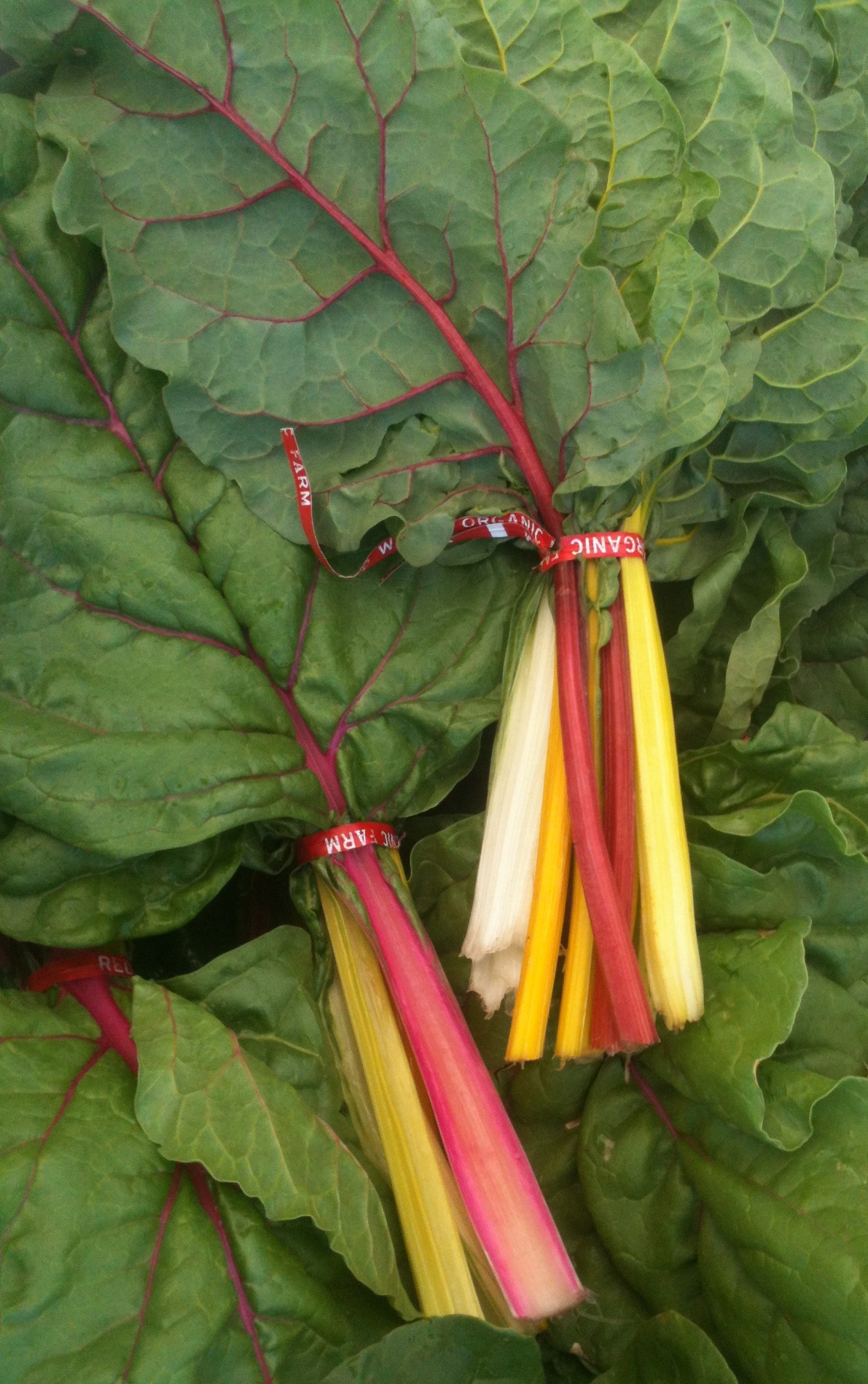
Rainbow Chard

Rainbow Chard

Regular Share
-Carrots
-Snow Peas
-Hakurei Turnips
-Choice: Lettuce OR Braising Mix
-Choice: Kale OR Chard OR Collards OR Broccoli Raab OR Bok Choi
-Choice: Favas OR Beets OR Cauliflower

Large Share
-Double Snow Peas
-Cauliflower
-Garlic

Posted in 2014, Farm, Newsletter | Comments Off on CSA week 6

The Market Truck

One thing that is important on the farm is transportation – in the form of our farm trucks. From depositing coolers in the proper fields for the next day’s harvest to delivering restaurant orders to dumping compost in the compost pile at the end of the harvest day, these vehicles are crucial to maintaining working order on and off the farm. The big white beast you see at the CSA pickups is our market truck. This truck, an old ’83 GMC, weighing in at over 23,000 pounds and about 25 feet long, can hold close to 75 of the large white coolers and is responsible for carrying the contents of our CSA shares to our pickups 3 days a week and all the produce to the market on Saturdays. I, being a vintage one year older, but of a much smaller stature, am responsible for driving her to and from the pickups with all the freshly harvested veggies.

Learning to drive such a large old vehicle was a daunting task, but I have grown to like the tri-weekly event. Before each outing, I go through a check list. First, check the headlights and turn signals, among a few other items, to assure all are in working order. Check the oil and fuel level and fill if needed.

Though old and sometimes temperamental, there is a finesse in driving this large truck. Getting her to start may require pulling out the choke, give her two pumps from the gas pedal, but not much more or risk flooding the engine (which I am guilty of on occasion). From inside the cab, when the truck turns over, I think it sounds much larger and meaner than from the outside. As I drive, I am aware of every sound, especially if there is a new one, and I constantly check my periphery in the mirrors. When I shift, I listen to the engine and watch the RPMs to be sure I don’t shift too late and push the engine too hard. This year, with a new clutch, shifting is much easier and doesn’t require me putting my whole body weight behind my foot.

There is always a little bit of relief when I pull into the pickup sites. The target time to arrive is around 3pm, which gives us about an hour to unload the contents of the truck. Set up of the tents and tables. Weigh the greens, like lettuce, arugula and sorrel and get ready for the 4pm pick up time. We’ll see you this week!

Posted in 2014, Farm | Comments Off on The Market Truck

Potluck Grain Salad

Once a month I get together with a group of food loving girlfriends for dinner. We take turns hosting the meal at our homes, and each month we pick a different theme for dinner. Saturday we were at my friend’s Amy’s house and she picked  “Summer Party Food” for the theme. As always there was lots of good food, but one dish stood out. Karin, another friend, made a salad made based on this recipe http://eating-made-easy.com/2014/05/31/corn-salad/

Karin changed some of the components of her salad based on what she had. She used Israeli couscous (basically pasta) instead of grains, omitted the corn, and used cilantro instead of basil. The salad was delicious and complemented everything else on the plate.

I made the salad last night and I used some of the vegetables I got in my CSA share this week, kale, basil, garlic scapes, and peas. I had some strawberries in my garden so I used those. Any of the salad ingredients can be substitute for whatever is in season, or what you have on hand. The dressing seems really basic, but it hits all the right notes for balance.

This is hearty, travels well, keeps well, is versatile, is good for you, and delicious! What more could you ask for in a salad? I wish I took a picture of Karin’s salad, it looked totally different than mine.

Basil topped salad

Here is the recipe as written, with my changes to the side.

Ingredients

  • For the Salad:
  • 3 cups cooked grains (I used faro)
  • 1 English cucumber, seeds removed and sliced into thin half moons (I used peas)
  • 1 cup fresh blueberries (I used strawberries)
  • Kernels from 3 ears of cooked corn on the cob (I used shredded kale)
  • 1/2 cup chopped red onion (I used about 1/4 cup of chopped garlic scapes)
  • Handful of fresh basil leaves, chopped
  • 1/2 tsp salt
  • 1/2 cup crumbled goat cheese (optional, I didn’t use any cheese)
  • For the Dressing:
  • 1/2 cup  whole milk yogurt (I used Greek yogurt)
  • Juice of 1 large lemon
  • 3 Tbsp honey (I used less, like 1 1/2 tablespoons)
  • 3 Tbsp extra virgin olive oil
  • 2 Tbsp finely chopped fresh basil leaves
  • 1/2 tsp salt
  • Pinch of freshly ground black pepper

Instructions

  1. In the bottom of a large bowl, whisk together all the dressing ingredients.
  2. Add the grains, cucumber, onion, basil and corn kernels and gently toss together.
  3. Gently fold the blueberries and goat cheese (if using) into the salad and taste for seasonings. Add more salt & pepper, or more lemon juice if needed.
Posted in 2014, Recipes, Salads-Spring-Summer | Comments Off on Potluck Grain Salad

Fava Bean Preparation and “How-To” Grill Fava Beans

Here is a basic fava bean preparation for most any recipe calling for favas, save grilled favas.

There are three steps to preparing a Fava Bean:
1. Removing the beans from the pod.
2. Blanching the beans in boiling water, that you removed from the pod, to soften for easy removal of the outer shell.
3. Peeling off the outer shell before eating or cooking to end with a bright-green, tender-scrumptious bean!

In the picture you can see the steps, except I didn’t show blanching the beans. You know what boiling water looks like, right?

first peel

The bright tender inner bean is what you are after.

second peel

A pound of fava beans yields a heaping 1/2 cup of recipe ready fava beans. You can simply eat favas with a little butter and salt, or add them to almost any pasta dish or salad.
I hope you enjoy your favas, I know I will!!

If Fava beans seem a bit too fiddly for you, you might like to grill your favas.
Grilled Favas

Toss the fava bean pods with olive oil and salt and some herbs if you have some on hand. Arrange them in a single layer on a grill over medium-high heat. Grill until blistered on one side – 4 to 5 minutes, then flip and grill for a few minutes more on the other side. You want the fava beans to be smooth and creamy when you pop them out of their skins – not undercooked. They will keep steaming in their pods for a few minutes after they come off the grill. Season the grilled favas with a bit more salt. To eat: tear open the green pods, take a fava bean, pinch the skin and slide the bright green fava from its skin into your mouth. All the char, oil, herbs and fava juices stick to your fingers…so lick them. The whole experience is really tasty. I hope you try it.
Grilled Favas
See the bright green beans that have been removed from the pod and then the skin? That’s what you eat.

Posted in 2014, Beans, Recipes | 3 Comments

CSA week 5

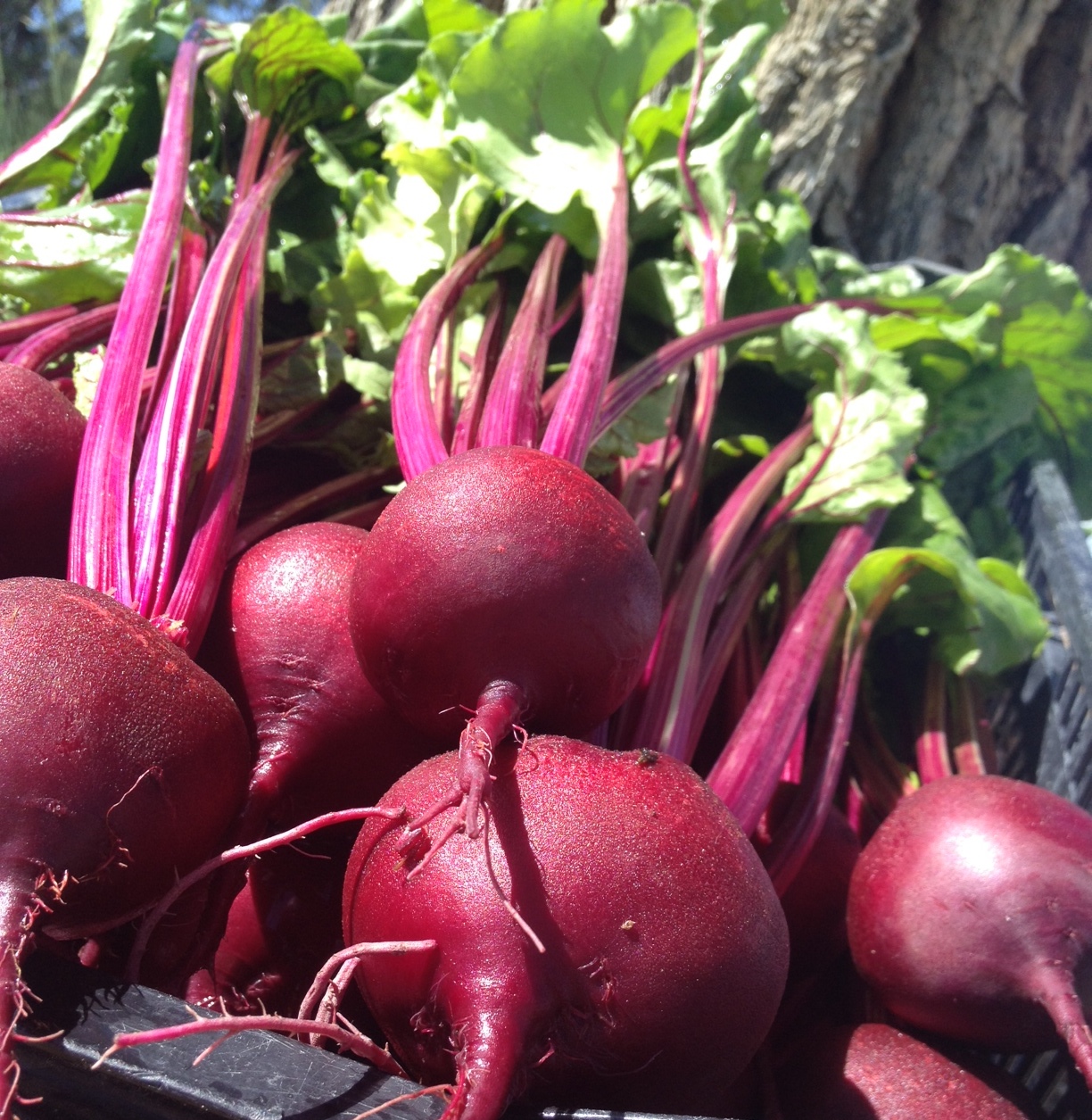
It’s Week 5 and the beets are here! This week we hope to bring you…Beets Loose

Regular Share
-Sugar Snap Peas
-Choice: Kale OR Chard OR Collards
-Choice: Shallots OR Garlic
-Choice: Braising mix OR Lettuce
-Choice: Baby Beets OR Fava Beans
-Herb choice: Basil OR Chives OR Cilantro OR Dill OR Mint OR Mixed Herb Bunch

Large Share Additions
-Baby Carrots
-Double Sugar Snap Peas
-Extra Choice: Kale OR Chard OR Collards

Posted in 2014, Farm, Newsletter | Comments Off on CSA week 5

Arugula Salad. Let’s talk about arugula.

Arugula, either you love it or you…don’t love it. I am in the love it category and to date, I haven’t felt the need to evangelize it’s merits.

I just read a book called “Eating on the Wild Side” by Jo Robinson. A book review is beyond the scope of this blog. But, encouraging CSA members to try some food outside of their comfort zone, like arugula, that I have learned is rich in cancer-fighting compounds  glucosinolates and high in antioxidant activity is not.

I often hear how people don’t like the peppery bite or bitterness of arugula. Let me show you how to tame arugula a little with a very simple preparation. Olive oil, lemon and Parmesan cheese. The fat in the oil and the cheese tame the heat and the bitterness of the arugula. Also, tearing the arugula bruises the leaf a little and that tones the sharpness of the greens as well. The lemon’s tartness detracts your taste buds from the bitterness too and the salt adds a brightness as well.

Ingredients
1 bag of arugula, washed, dried, and torn into small bite size pieces.
a good glug of extra-virgin olive oil
1/2 lemon
Salt and freshly ground black pepper
A chunk of Parmesan
Directions
In a serving bowl, drizzle the arugula with the oil, squeeze in the lemon juice, and sprinkle with salt and pepper. Toss with your hands, make sure all of the leaf is covered and taste for seasoning. Use a vegetable peeler to shave thin pieces of Parmesan over the top.

If you don’t have Parmesan use any cheese. You can add anything from here, fruit, dried or fresh. Nuts are great and again help tone down the sharpness of the arugula and add protein-win!

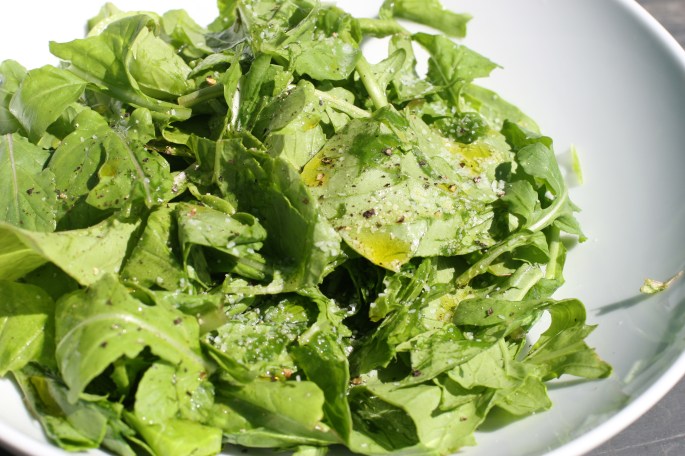
In these pictures I am trying to show you the small amount of oil and lemon you need to dress the greens. The first is arugula torn into small pieces with oil, lemon, salt and pepper. The second is mixed. It is a very light dressing but takes the edge off the peppery bite.

Dress Arugula Arugula


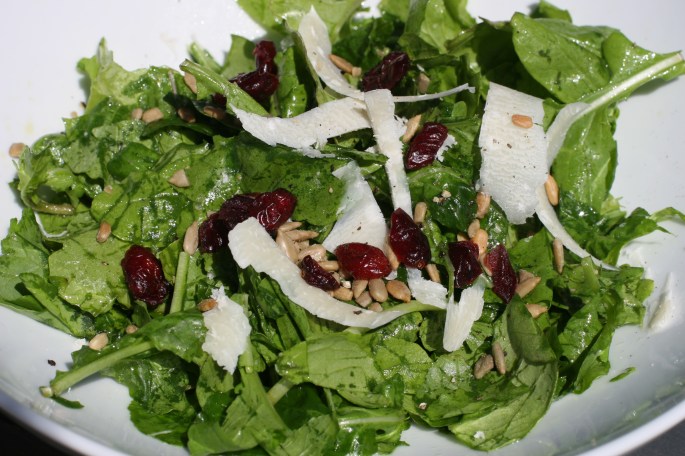
Now add what ever else strikes your fancy that you have in your pantry and enjoy.

Salad with Toppings

I really hope you non-arugula lovers try this. You arugula lovers already know how good this is!

Have a great week.

mo


Posted in 2014, Arugula, Recipes | Comments Off on Arugula Salad. Let’s talk about arugula.

Harvest All Ready

This Friday we harvested sugar snap peas for the first time this season. The harvest list read: “pick all ready.” With the plants usually producing for about two weeks, these surprisingly sweet little green pods are a short-lived treat of the spring. Harvesting them can be tricky and their very thought can inspire backaches for those whose bodies remember last year’s crop- but boy are they worth it!
in the peas
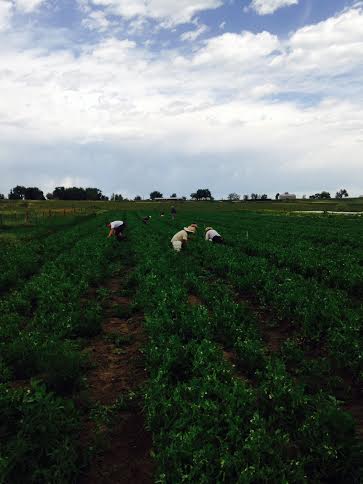
On the north side of the farm, there are six long beds of sugar snaps that are each, to my best estimate, close to one hundred yards long (though this estimate may be hyperbolized based on the six hours I spent in them on Friday). Each of these beds is about four feet wide with about eighteen inches between them- just enough for one body to work up and down the row. Each bed contains four lines of plants. When harvesting, we work two to a bed with each worker responsible for the two lines closest to them.

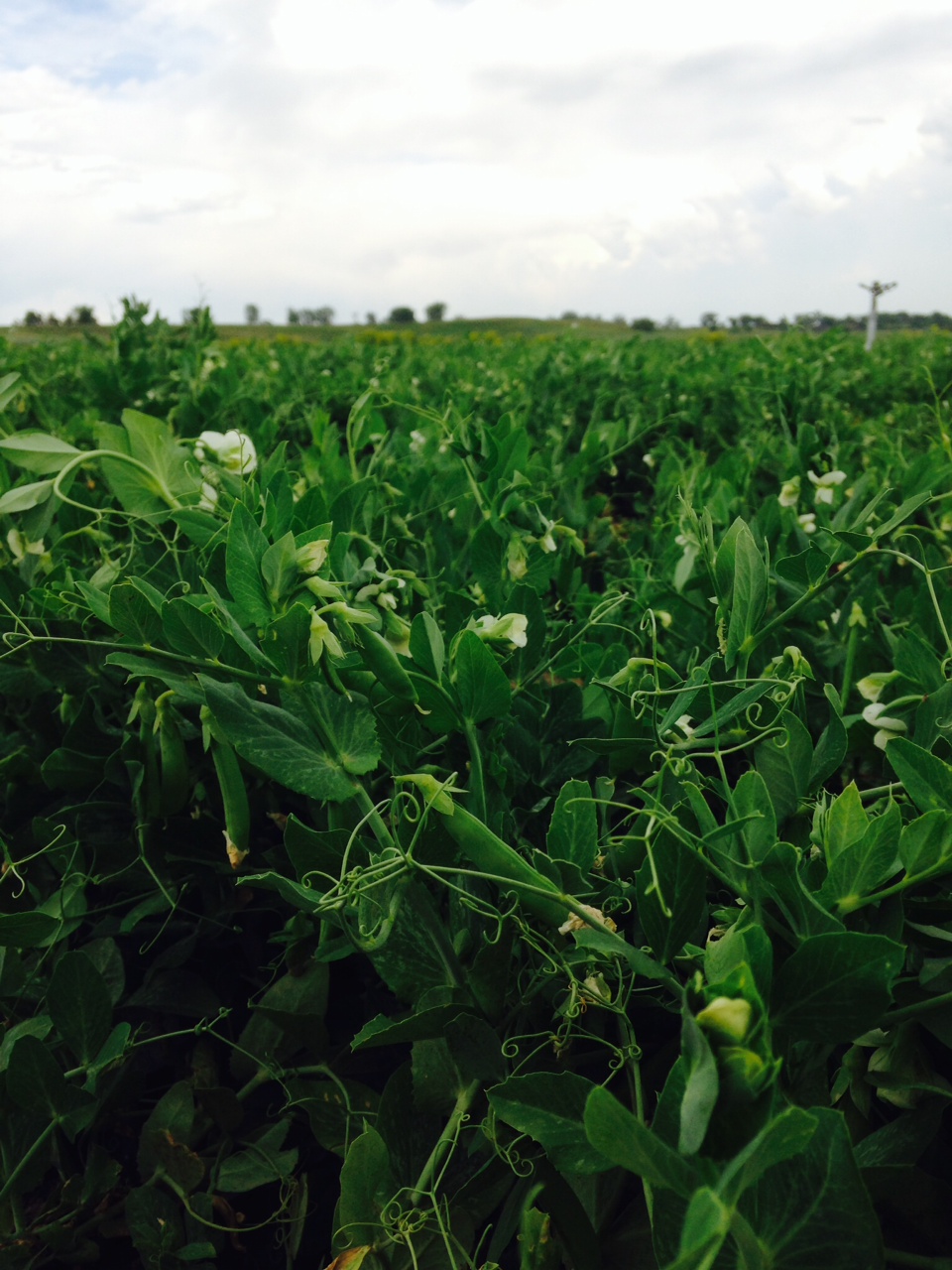
Not that long ago, this field, now teeming with green pods of various sizes, was blanketed with a snow of sweet-smelling white blossoms. The first of these blossoms have quickly turned into the round slightly curved pods we know as sugar snap peas. The first fruits develop close to the ground and work their way up the plant as it matures. When harvesting them, either kneeling or bending at the waist, one must gently pull back the plants to reveal the peas that are ready to pick. A little game of hide and seek. Be efficient, but careful not to pull the plant out of the ground and don’t miss any that are plump and ready.

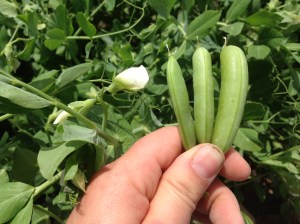
stages of peasBeing able to differentiate between pods that have reached their peak and those who need to remain on the plant to fatten more is probably one of the more difficult tasks. Pick them too soon when they are thin and they won’t reach the potential of their full sweetness- wait too long and their outer pod turns an unappetizing yellow and slightly translucent with the pod sometimes splitting to reveal the wrinkly individual peas inside. When over ripe their taste is close to bitter and their texture, woody. Quality control of the utmost importance. The pod on the farthest right is the sweetest sugar snap pea you could possibly taste and what were were looking to harvest.
Along with deciphering the sugar snap peas’ ripeness are two other anomalies. They, too, are pea pods, but are pale in comparison to the sugar snaps in taste. One is a thin skinny pod that looks similar to a snow pea, but has nearly no flavor, and the other is a long straight pod that looks like a boat and feels like a biting into a bunch of tiny woody threads. Eating either of these is usually followed by spitting them onto the ground, especially after snacking on the real thing. We do not want these to make their way to the market or into a CSA share. Tasting the produce is important to understand the differences- a boon when you are waiting for lunch.

This Friday we methodically went through each of the six beds once, followed by a second run through. We came away with a half cooler- to guess, approximately sixty pounds. Many of the pods that were in the field on Friday were so close to being ready. The harvest for this coming week’s CSA should be bountiful.

Posted in 2014, Farm | 1 Comment

CSA week 4

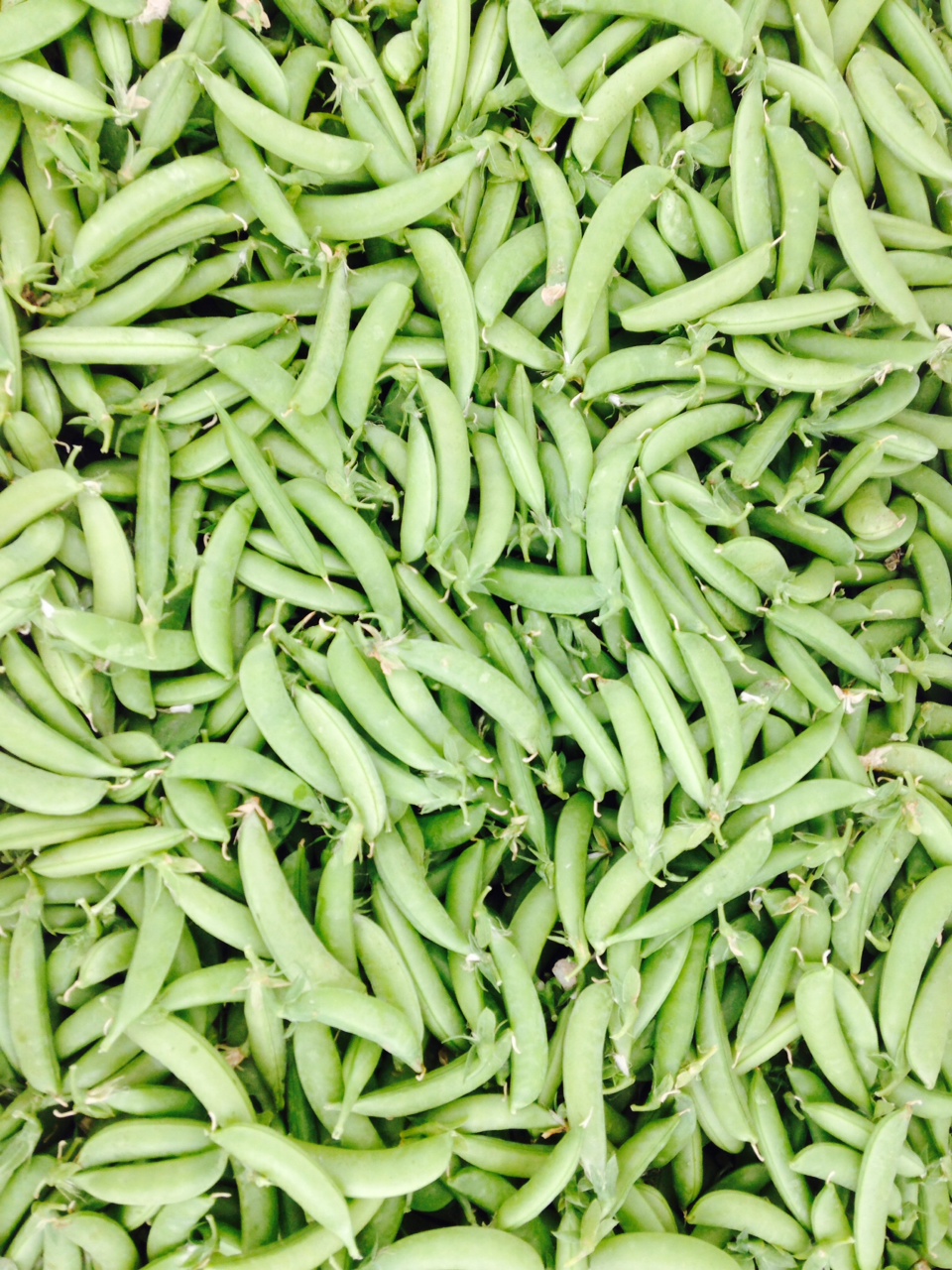
The Sugar Snap Peas are here! They are sooo good, here’s some pics of them.

The Vines

The Vines

This week we hope to bring you:

Regular Share
Sugar Snap Peas
Garlic Scapes
Choice: Hakurei Turnips OR Scarlet Turnips
Choice: Lettuce OR Arugula
Choice: Kale OR Chard OR Collard Greens
Herb choice: Sorrel OR Garlic Chives OR Cilantro OR Dill OR Mint OR Oregano, Sage OR Thyme OR Mixed herb bunch

Large Share
Double Sugar Snap Peas
Garlic Scapes
Choice: Hakurei Turnips OR Scarlet Turnips
Choice: Lettuce OR Arugula
Choice: Kale OR Chard OR Collard Greens
Herb choice: Sorrel OR Garlic Chives OR Cilantro OR Dill OR Mint OR Oregano, Sage OR Thyme OR Mixed herb bunch
Spinach
Shallots

Harvesting

Harvesting

The Goods

The Goods


Posted in 2014, Farm, Newsletter | 2 Comments